Ankle Sprain Management: How Physiotherapy Helps You Recover and Prevent Re-Injury
An ankle sprain can happen in seconds. You may land awkwardly while playing a sport, miss a step, walk on an uneven surface, or suddenly twist your foot. What initially appears to be a minor injury can cause pain, swelling, difficulty walking, and loss of confidence in the ankle.
Although many people assume that an ankle sprain simply needs a few days of rest, effective recovery often involves much more.
Appropriate assessment and progressive rehabilitation are important because an ankle sprain can affect mobility, strength, balance, and movement control. Clinical guidelines for lateral ankle sprains emphasize structured rehabilitation, therapeutic exercise, progressive weight bearing and appropriate external support as important components of management.
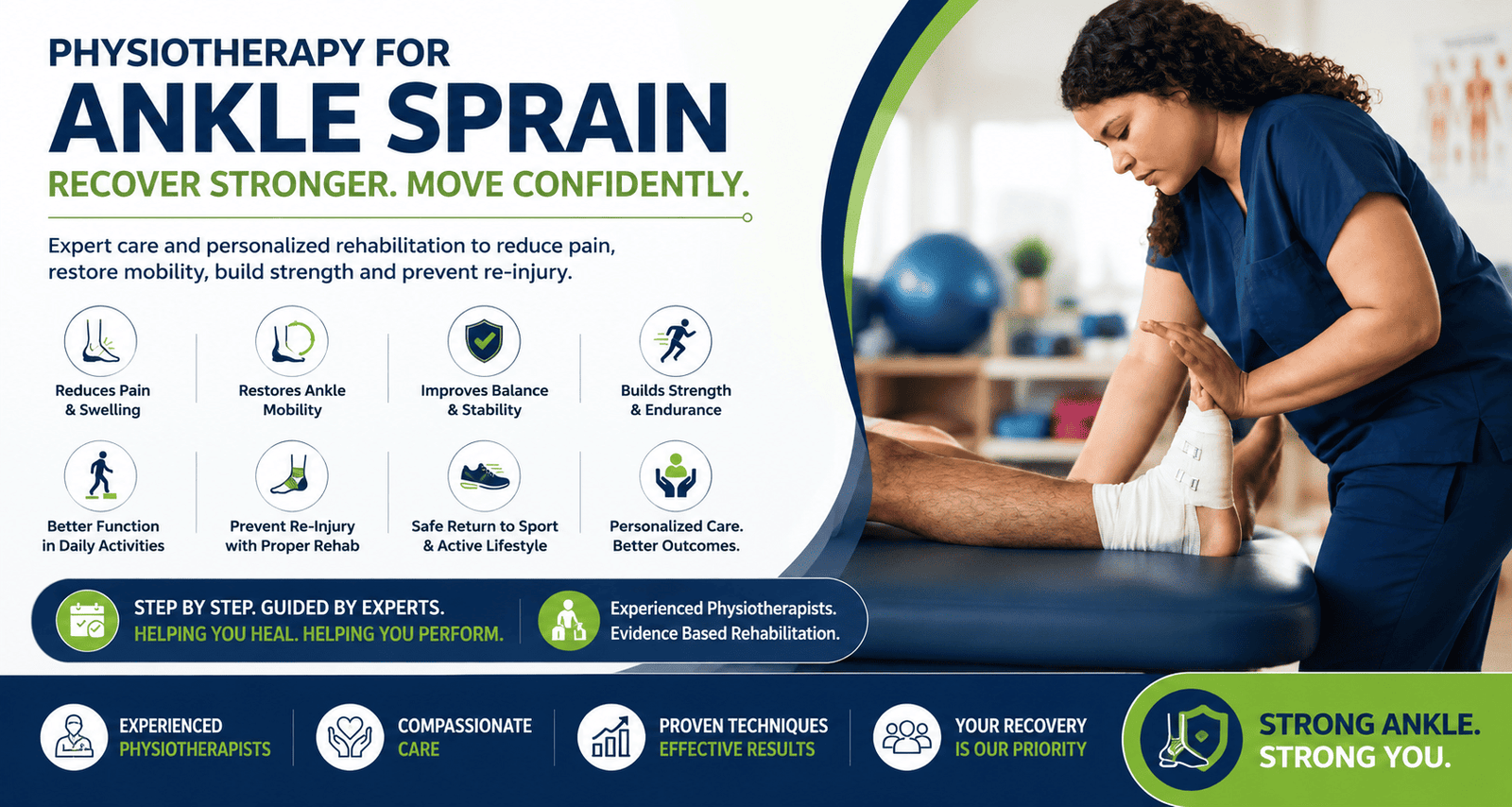
At Siliguri Physio, ankle sprain physiotherapy focuses on helping patients safely regain movement, rebuild strength and gradually return to everyday activities, exercise or sport through an individualized rehabilitation plan. Siliguri Physio describes its approach as combining personalized treatment plans with rehabilitation techniques aimed at restoring mobility and improving recovery.
What Is an Ankle Sprain?
An ankle sprain occurs when one or more ligaments supporting the ankle are stretched or injured beyond their normal capacity.
A common type is a lateral ankle sprain, which typically affects the ligaments on the outside of the ankle. However, ankle injuries can vary considerably depending on how the injury occurred and which structures are involved.
Common symptoms may include:
- Ankle pain
- Swelling
- Bruising
- Difficulty walking
- Reduced ankle movement
- Tenderness around the injured area
- A feeling of weakness or instability
The severity of symptoms can vary from relatively mild ligament injury to more significant damage requiring a longer rehabilitation period.
Because not every painful or swollen ankle is simply a ligament sprain, an appropriate clinical assessment is important—particularly when pain is severe or weight bearing is difficult. Clinical practice guidelines recommend considering factors including the ability to bear weight, pain, ankle range of motion, previous ankle sprains, balance and perceived instability when assessing recovery and prognosis.
Why Is Proper Ankle Sprain Management Important?
One of the biggest mistakes after an ankle sprain is focusing only on reducing the initial pain and swelling.
Feeling better does not necessarily mean that the ankle has fully regained its previous strength, balance or ability to cope with demanding movements.
Without appropriate rehabilitation, some people may continue to experience:
- Repeated ankle sprains
- A sensation that the ankle may “give way”
- Reduced balance
- Loss of ankle mobility
- Weakness
- Difficulty returning to sport
- Reduced confidence during movement
This is one reason ankle sprain rehabilitation often progresses beyond symptom relief to restoring the physical abilities required for work, daily activities and sport. The Physio Network management framework similarly progresses from symptom management and external support toward mobility, strengthening, balance, multi-joint exercises and eventually sport-specific activity.
Physiotherapy Management for an Ankle Sprain
There is no single exercise or treatment that is appropriate for every ankle sprain.
The rehabilitation programme should be based on factors such as the type and severity of the injury, pain levels, mobility, strength, balance and the activities the individual needs to return to.
Here are some of the main components that may be included in ankle sprain physiotherapy.
1. Initial Assessment
The first step is understanding exactly what happened.
A physiotherapist may assess:
- How the injury occurred
- Location of pain and swelling
- Ability to stand and walk
- Ankle range of motion
- Muscle strength
- Balance and stability
- Previous history of ankle injuries
- Functional movements
The assessment can help determine an appropriate rehabilitation strategy and whether medical evaluation or additional investigation may be needed.
A particularly painful injury, significant inability to bear weight, substantial deformity or symptoms suggesting a possible fracture require appropriate medical assessment rather than simply assuming the injury is an uncomplicated ankle sprain. The Ottawa Ankle Rules were developed as a clinical decision tool to help trained clinicians determine when radiography may be appropriate after acute ankle and midfoot injuries.
2. Protecting the Ankle While Restoring Movement
During the early stage of recovery, the ankle may be painful and swollen.
Management may initially focus on protecting the injured structures while gradually restoring comfortable movement and weight bearing according to the severity of the injury.
Current clinical guidelines support progressive weight bearing with appropriate external support, such as a brace or taping, based on the severity of the injury and the person’s symptoms.
The objective is not simply to keep the ankle completely inactive for an unnecessarily long period. Rehabilitation should gradually prepare the ankle to tolerate normal movement again.
3. Manual Therapy
Some patients experience stiffness or restricted ankle movement following a sprain.
Where clinically appropriate, physiotherapists may use manual therapy techniques to assist with short-term improvements in pain and ankle mobility.
The goal is usually to make movement more comfortable so the patient can participate more effectively in active rehabilitation.
The reference management approach from Physio Network similarly positions manual therapy as a supportive intervention, particularly for painful or restricted ankles, while emphasizing exercise as the central component of rehabilitation.
Manual therapy should therefore generally form part of a broader rehabilitation programme rather than being considered the entire treatment.
4. Taping and Ankle Support
Taping or an ankle brace may sometimes provide additional support during the recovery process.
Depending on the individual, external support may help with protected weight bearing or provide additional confidence when gradually returning to activity.
However, a brace or tape alone does not restore ankle strength, balance or movement control.
Clinical guidelines recommend external support alongside a structured therapeutic exercise programme for acute lateral ankle sprains and do not support relying on external support alone to address chronic ankle instability.
5. Restoring Ankle Mobility
Ankle movement can become restricted after a sprain due to pain, swelling or temporary reduction in activity.
Physiotherapy exercises may therefore focus on gradually restoring comfortable range of motion.
This may involve exercises targeting movements such as:
- Dorsiflexion
- Plantarflexion
- Inversion
- Eversion
The exercises selected depend on the injury and stage of recovery.
Restoring mobility can be particularly important before progressing to more demanding functional exercises such as squatting, running, jumping and changing direction. Progressive restoration of ankle range of motion is also a key element of the rehabilitation approach described in the reference article.
6. Strengthening the Ankle and Lower Limb
Once appropriate, rehabilitation usually progresses toward strengthening.
Exercises may target the muscles responsible for controlling different directions of ankle movement as well as the calf and other muscles throughout the lower limb.
The rehabilitation programme may progress from relatively simple exercises to:
- Resistance exercises
- Heel raises
- Squats
- Lunges
- Single-leg exercises
- Functional strengthening
For active individuals and athletes, rehabilitation may also need to consider the strength of the entire lower limb rather than concentrating exclusively on the ankle.
Clinical guidelines recommend structured therapeutic exercise that can include protected active range of motion, neuromuscular training, postural re-education and balance training.
7. Balance and Proprioception Training
Have you ever recovered from an ankle sprain but still felt that the ankle was unreliable?
This can be one of the reasons balance and neuromuscular training are important.
Rehabilitation may begin with relatively simple exercises such as standing on one leg and gradually progress by changing:
- The supporting surface
- Visual input
- Body position
- Direction of movement
- Speed
- External resistance
More advanced exercises may involve reaching, catching, stepping or performing sport-specific movements.
The objective is to progressively challenge the body’s ability to maintain control during increasingly demanding activities.
Exercise and balance-focused rehabilitation are strongly emphasized in clinical guidance for both acute ankle sprain management and chronic ankle instability.
8. Running, Jumping and Plyometric Training
For athletes and highly active individuals, being able to walk without pain is usually not enough to demonstrate readiness for sport.
The ankle may eventually need to tolerate:
- Running
- Jumping
- Landing
- Hopping
- Acceleration
- Deceleration
- Cutting
- Rapid changes of direction
These activities should generally be introduced progressively according to the individual’s rehabilitation status and sporting requirements.
A person recovering for recreational walking will naturally require a different programme from a footballer, badminton player, dancer or runner.
This is why ankle sprain rehabilitation should be individualized rather than based on a fixed, one-size-fits-all exercise routine.
The Physio Network model similarly progresses rehabilitation from ankle and foot exercises through balance and multi-joint strength training before introducing plyometrics, running, acceleration, deceleration and change-of-direction drills.
When Can You Return to Sport After an Ankle Sprain?
Returning to sport should not be determined solely by the number of days or weeks since the injury.
An international consensus introduced the PAASS framework for considering return-to-sport decisions after an acute lateral ankle sprain. It considers five broad domains:
P – Pain
Pain during sport and over the previous 24 hours.
A – Ankle Impairments
Factors such as ankle range of motion, strength, endurance and power.
A – Athlete Perception
The individual’s confidence, perceived stability and psychological readiness.
S – Sensorimotor Control
Balance and proprioception.
S – Sport/Functional Performance
Hopping, jumping, agility, sport-specific drills and the ability to complete training.
This reinforces an important principle: returning to sport is about restoring function and confidence, not simply waiting for the pain to disappear.
How Long Does an Ankle Sprain Take to Recover?
There is no single recovery time that applies to everyone.
Recovery depends on factors including:
- Severity and type of injury
- Ability to bear weight
- Previous ankle injuries
- Pain levels
- Ankle mobility
- Balance
- Individual activity demands
- Quality and progression of rehabilitation
These factors are among those recommended for consideration when clinicians estimate the likely course of recovery following a lateral ankle sprain.
Rather than comparing your recovery with someone else’s, it is more appropriate to progress according to your symptoms, physical function and rehabilitation goals.
Ankle Sprain Physiotherapy in Siliguri
An ankle sprain may appear to be a simple injury, but successful recovery involves more than waiting for swelling and pain to disappear.
A well-structured physiotherapy programme can focus on progressively restoring:
Mobility → Strength → Balance → Movement Control → Functional Performance → Return to Activity
At Siliguri Physio, the clinic’s stated approach emphasizes individualized rehabilitation and personalized treatment plans designed to improve mobility and support recovery.
Whether your ankle injury happened while playing sport, exercising, walking or performing everyday activities, an appropriate assessment can help identify your functional limitations and guide your rehabilitation.
Take the Next Step Towards a Stronger Ankle
Don’t let an ankle sprain keep you away from the activities you enjoy—or allow an incompletely rehabilitated ankle to affect your confidence in movement.
Contact Siliguri Physio for professional ankle sprain assessment and physiotherapy rehabilitation in Siliguri.
A personalized programme can help you work towards restoring ankle movement, rebuilding strength, improving balance and safely returning to your everyday activities or sport.
Book your appointment with Siliguri Physio and take the next step towards moving confidently again.
Medical Disclaimer: This article is for general educational purposes only and is not a substitute for individual medical diagnosis or treatment. Seek appropriate medical care for severe pain, significant swelling or deformity, inability to bear weight, numbness, worsening symptoms, or concerns about a fracture or serious injury.